If you’ve been around game discovery communities enough, you’ve most likely heard the term “sticky games”. We first heard about it in Ryan K. Rigney’s Push to Talk newsletter, where he spoke about the issue of loyal players getting “stuck” on their favorite games, particularly live service games. They may dabble in new releases with similar aesthetics, gameplay systems, or by the same publisher/developer, but they ultimately return to the comforts of their favorite franchise (Why? Read Ryan’s full newsletter above to see some possible reasons). These sticky games are typically older titles which keep their fanbase in a hold and stymie the efforts of new entrants to break into the space.
But these older titles don’t have complete dominance over the gaming space: There are many popular titles released over the last several years that have managed to break through and attain a “sticky game” status of their own. In this article, we’ll be looking at popular games released since 2019 to see which games have managed to keep their fanbase tuned in week-over-week on live-streaming platforms.
TL;DR Takeaways by Stream Hatchet:
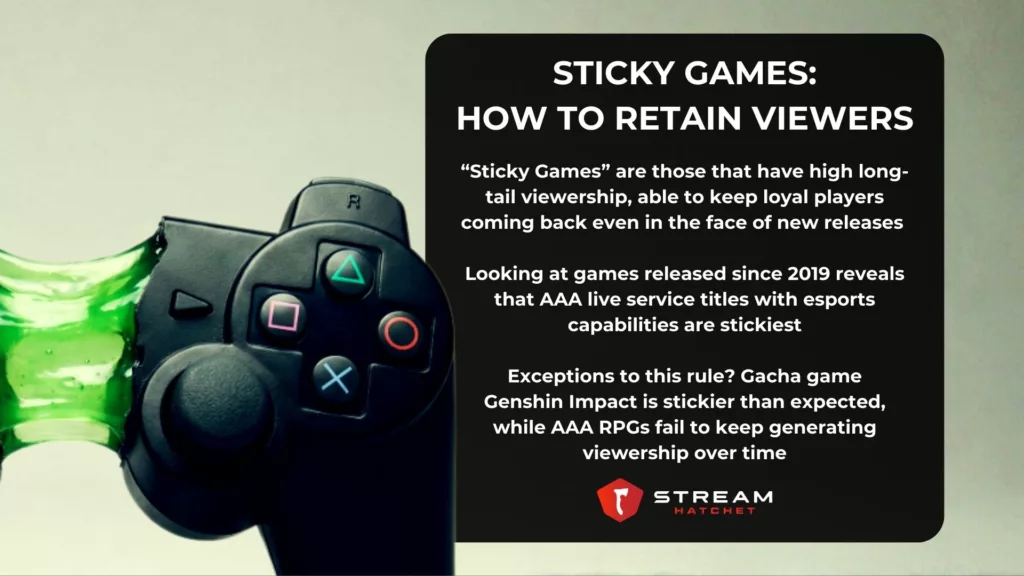
- “Sticky Games” are those that have high long-tail viewership, able to keep loyal players coming back even in the face of new releases
- Looking at games released since 2019 reveals that AAA live service titles with esports capabilities are stickiest
- Exceptions to this rule? Gacha game Genshin Impact is stickier than expected, while AAA RPGs fail to keep generating viewership over time
AAA Titles and Shooters Consistently Generating Viewership Over Time
For this analysis, we curated a sample of 25 games across a range of genres, publishers, and target audiences to get as wide a view as possible of the stickiness of different types of games (both live service and non-live service). The unifying similarity between these games is that they were all released from 2019 to 2023, meaning they’re new but also have enough data for us to make determinations about their long-term health. We then looked at how these games performed…
- Upon Launch: Their average hours watched across their first 4 weeks
- Over Time: The % of weeks since release that they managed to achieve over 1M hours watched (this 1M threshold was chosen based on our experience of reporting on successful games)
_
By plotting these two metrics against one another, we gain a fairly good understanding of which games are simply hits on launch and which are able to stand the test of time.
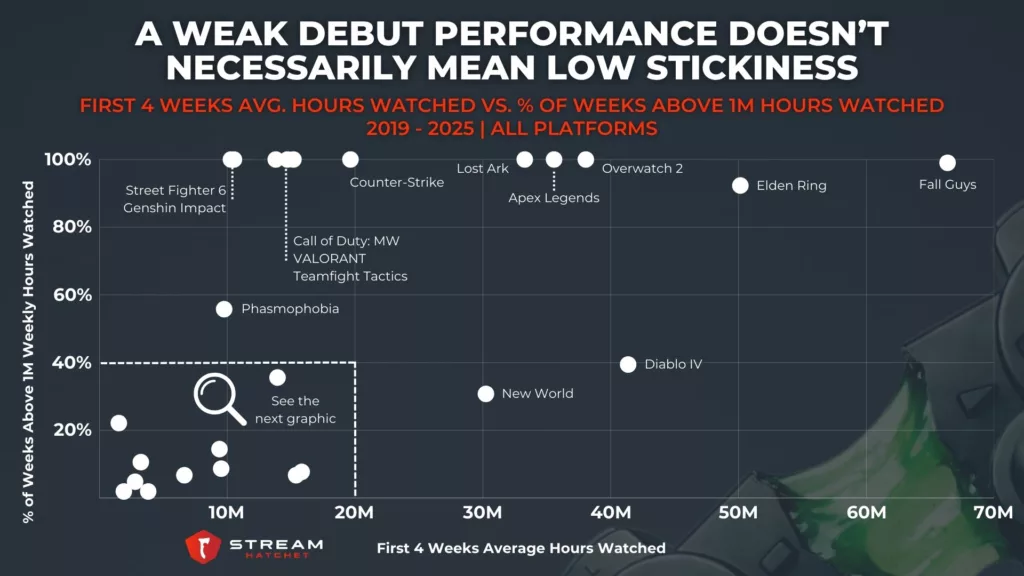
Out of 25 games sampled, 9 of these games were able to reach over 1M hours watched every single week since release. Interestingly, this long-term success seemed independent of the relative success of these titles in their first four weeks: Games like Overwatch 2 and Lost Ark had twice the short-term average of games like Counter-Strike (really Counter-Strike 2) and Teamfight Tactics, but all of them achieved the 100% milestone.
Almost all of the games in this 100% club, however, are sequels from pre-established franchises (e.g., Street Fighter 6, Call of Duty: Modern Warfare). Exceptions like Gacha game Genshin Impact and MMO Lost Ark were able to break through by starting in more niche regions (Japan and Korea, respectively) and then maintaining these audiences with consistent live service updates. There was also one massive outlier here, with Fall Guys having an incredible debut of 66.4M hours watched on average across its first four weeks and continuing to pull over 1M hours watched (almost) every week since then. But in this example, the pandemic-era lift in viewership and “new” party platformer genre helped raise the game’s profile.
We also wanted to highlight one of the games floating in “no man’s land” here. Diablo IV has the hallmarks of a sure-fire long-term success: A sequel in an established franchise with live service updates. But despite the game’s launch period success (41.4M hours watched), it has only since been able to break 1M hours watched around 39% of the weeks it’s been out. Our guess is this has to do with the relative lack of direct player interaction: While competitive games spark viral interactions suited for live-streaming audiences, the Diablo IV gameplay loop is relatively single-player focused. Additionally, the end game (where hardcore players spend most of their time) was criticized by the core fanbase upon release.
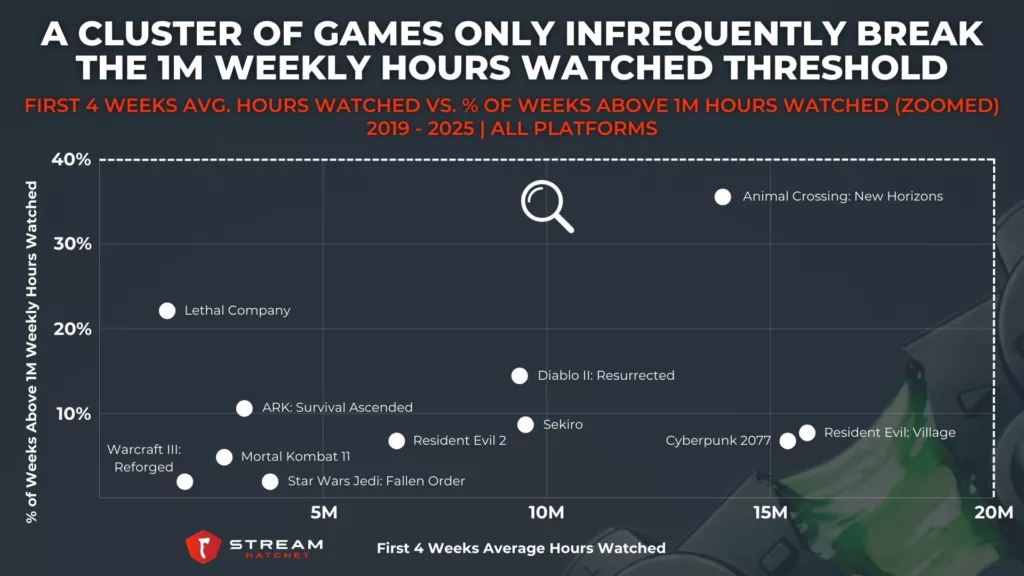
Looking more generally at the spread of games in this sample, there’s a clear cluster of games in the bottom-left corner here. 11 of the 25 games sampled had less than 20M hours watched on average across their first 4 weeks and less than 40% of their weeks since release achieved above 1M hours watched. Although all of the games in this cluster are commercial successes, they have strong contrasts to the previous games we discussed. They’re typically single-player titles with campaign modes (e.g. Sekiro, Resident Evil 2), or indie/casual titles (e.g. Lethal Company, Animal Crossing: New Horizons). Animal Crossing may be benefitting from the same effect as Fall Guys however, seeing massive initial success due to pandemic-era viewing.
While certain genres seem to cluster in either the more sticky group (MOBAs, Shooters) or less sticky group (Survival, Horror), RPGs have a lot more variation. Some like Cyberpunk 2077 and New World (as an MMORPG) have low stickiness, while others have managed to achieve high stickiness like Lost Ark and Elden Ring. Lost Ark’s ties to Amazon have no doubt helped it secure more viewership on Twitch and Elden Ring’s prestige as FromSoftware’s epic RPG/Souls-like title help explain why they broke out while other RPGs flounder. But later on in this article we’ll see that these RPGs might not vary in stickiness as much as it first appears…
Delivering Consecutive Weeks of Strong Viewership Requires Esports Support
The 1M threshold is useful for seeing how sticky games are on average, but publishers of certain types of games want to achieve consistency. Having games that peak and trough make it harder to predictably activate that fanbase when it comes to launching new content or hosting community events. So, for this same sample of 25 games, we decided to look at their longest streak of weeks above 1M hours watched since launch. We also ordered this data by how this streak compares to the total number of weeks since launch, to fairly compare games that have been out for different periods of time.
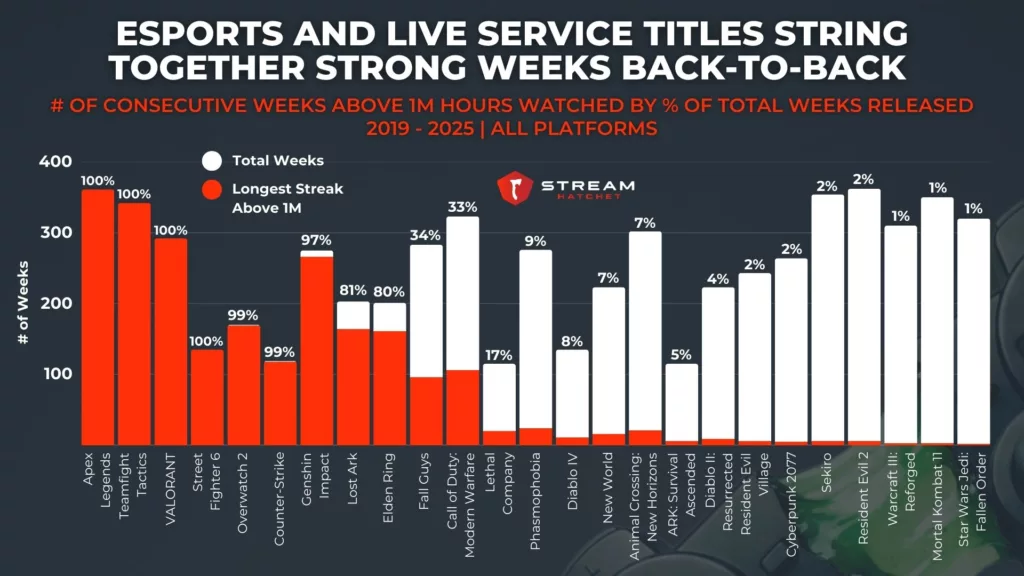
As you’d expect, many of our “100% club” members from the previous graphic rank highly here (Note: “100%” sometimes comes from rounding up, so some games like Genshin Impact and Lost Ark have actually had small breaks in their streaks). But there’s a clear split here between sticky games and non-sticky games: Right around Lethal Company there’s a massive drop off in streak duration from upwards of 80% of the total release time down to just 17% and lower. Streaks this short imply that viewership is being driven by one-off events and new content launches. But while viewers tune in for these events, they quickly lose interest and return to their regular sticky games.
As a general rule, each games’ longest streak typically begins upon release, as games have their largest peaks upon release and then attempt to sustain this interest over time. There are some rare exceptions here, however. Take Lethal Company which, as an indie game, did not immediately break out and instead gained traction in its second and third weeks as word-of-mouth spread.
Normalizing the Sample: Games that Drop Off After Launch Success
There’s an inherent issue with our 1M hours watched threshold. Using a single metric like this doesn’t account for the natural variances in popularity between games of different genres and by different developers/publishers. So, we decided to look at the data in a different way: This time, we’re looking at how these games performed…
- Upon Launch: Their average hours watched across their first 4 weeks (same as before)
- Over Time: The % of weeks since release that they managed to achieve over 25% of their debut week hours watched.
_
This new long-tail measure normalizes the sample, meaning that games that were more hyped anyways (typically thanks to huge AAA marketing budgets) are treated on a relative scale.
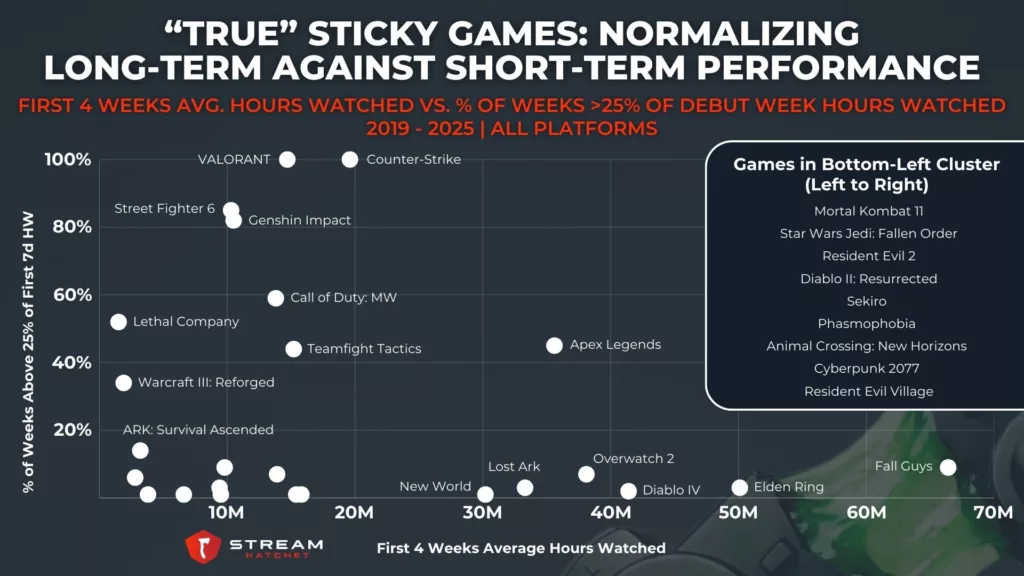
First of all, the differences: Normalizing against initial success, we now see that RPGs are all on the same level. Where before games like Elden Ring and Lost Ark seemingly had high stickiness, this way of viewing the data reveals that they still drop off rapidly post-launch and settle closer to the stickiness level of other RPGs like Cyberpunk 2077. This makes sense: Players and viewers will eventually exhaust the content in a story-driven game and be forced to try a new RPG instead, regardless of how much they love that IP.
Another difference: The LHS of the graphic (low initial popularity) has now spread out, moving up games that have notoriously hardcore fanbases and moving down games that have large but not particularly loyal audiences. As an example of the former, take Warcraft III: Reforged which improved to a stickiness of 34% under this new metric compared to just 2% before. Warcraft fans have proven their dedication to the world of Azeroth with their extensive modding community. As an example of the latter case, however, Teamfight Tactics dropped from 100% club status down to just 44% under this new metric. Auto battlers don’t inspire the kind of fervent devotion of more active titles, and this game’s success mostly depends on players’ love for the League of Legends IP.
But for all the differences here, the broader trends largely remain the same: Shooters and AAA titles generally have stickier status, and games with an esports presence are able to justify viewers consistently tuning in week-after-week. VALORANT and Counter-Strike (remember, that’s Counter-Strike 2 really) are the only two titles to achieve 100% stickiness under both measurements, with Street Fighter 6 close behind.
_
Whether you look at absolute viewership (our 1M threshold example) or relative viewership (normalizing long-tail viewership against launch viewership), there’s one common quality among sticky games: Esports presence. Now you may be thinking “that’s all well and good, but my game isn’t suited to a competitive scene”. Consider this though: It’s not really about being a competitive game. Stickiness is about having some aspect of your title that you can depend on, week over week, to keep the community engaged with new developments. Yes that could be esports, but it could also be community-run events like ARC Raiders’ Battle for Speranza, new content drops like Genshin Impact, or an active modding community like Minecraft.
Additionally, stickiness is mostly a concern for live service games. Titles that release new editions each year (like EA Sports FC 26) or which trade on the legacy of their publishers (like FromSoftware’s Souls-like titles) should rely on other measures of fan loyalty to see if their new titles will stir up interest upon release. Stickiness is just one way of creating a community, but we personally believe that there are many other ways to partner with streamers and leverage the intimacy of streaming to find your own community.
To keep up to date with the latest tips and tricks for capturing live-streaming audiences, follow Stream Hatchet and receive exclusive newsletter-only content: