Gaming audiences are more savvy than ever. Where fans once simply followed their favorite game franchises or console makers, they now studiously follow the studios and publishers behind them, tracking announcements, debating creative decisions, and building loyalty to entire portfolios. That shift matters enormously for live streaming, where a publisher’s reputation can drive audiences to a new release before a single review has been written. A beloved developer dropping a surprise announcement can send a game category surging overnight, while a studio with eroded trust may see their major launch underperform despite marketing spend.
Different publishers put different stock in the importance of live streaming for driving traffic to their titles: Some invest heavily in esports or live service community events like Twitch Drops. But in 2025 the publishers capturing the largest share of attention weren’t always the ones with the biggest release slates or the loudest marketing budgets. In this article, we break down which game publishers dominated live streaming in 2025 and how diversified their viewership is across their portfolios.
TL;DR Takeaways by Stream Hatchet:
- The most watched publishers on live streaming are mostly the publishers behind the top 10 games on live streaming
- However, older publishers like EA and Nintendo draw on their back catalogue to rival streaming giants
- Other publishers like Mojang AB (Minecraft) and Rockstar Games (GTA V) rely on just a single game to sustain interest among viewers
The Top 3 Game Publishers on Streaming Form A League of Their Own
Before we get down to brass tacks, a heads-up here: For the purposes of this analysis, we’ve restricted each game to just a single publisher. In cases where multiple publishers have legitimate claims to publishing rights for a title (e.g. in the case of one publisher handling regional distribution of a game, or one publisher being the parent company of another), we have only considered a single publisher as holding the “hours watched”.
This is done to avoid double counting games. For example, we have counted League of Legends as being only published by Riot Games, ignoring the fact that Tencent Games is Riot Games’ parent company. These determinations are based primarily on principal recognition: Which publisher is someone most likely to associate with the game being discussed?
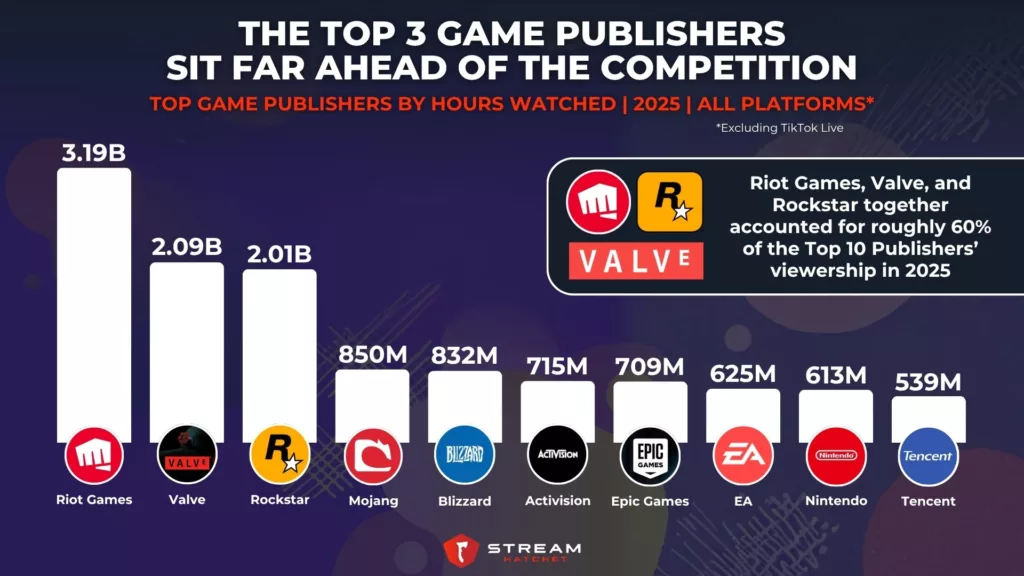
The live-streaming landscape in 2025 had a clear hierarchy when it came to game publishers. Riot Games led all publishers with 3.19B hours watched, followed by Valve at 2.09B and Rockstar at 2.01B. What makes those numbers remarkable is the gulf between them and everyone else. The #4 publisher, Mojang, sits at 850M hours watched, meaning there’s a gap of over 1.15B hours between 3rd and 4th place. This clearly creates two different tiers of top publishers (the reason why, we’ll see in a moment).
Taken together, the top 3 accounted for roughly 60% of the combined hours watched across the top 10 publishers. The remaining seven, from Mojang’s 850M down to Tencent’s 539M, are clustered within a tight 311M-hour window. It’s worth noting that Tencent’s 539M figure may be diminished here since we’re excluding TikTok Live where much of its mobile-first audience actually lives. Regardless, the margins separating these other publishers are far narrower than you’d expect given the varying scales of their respective libraries and fanbases.
The Top 10 Games Only Explain Some of the Top Publishers…
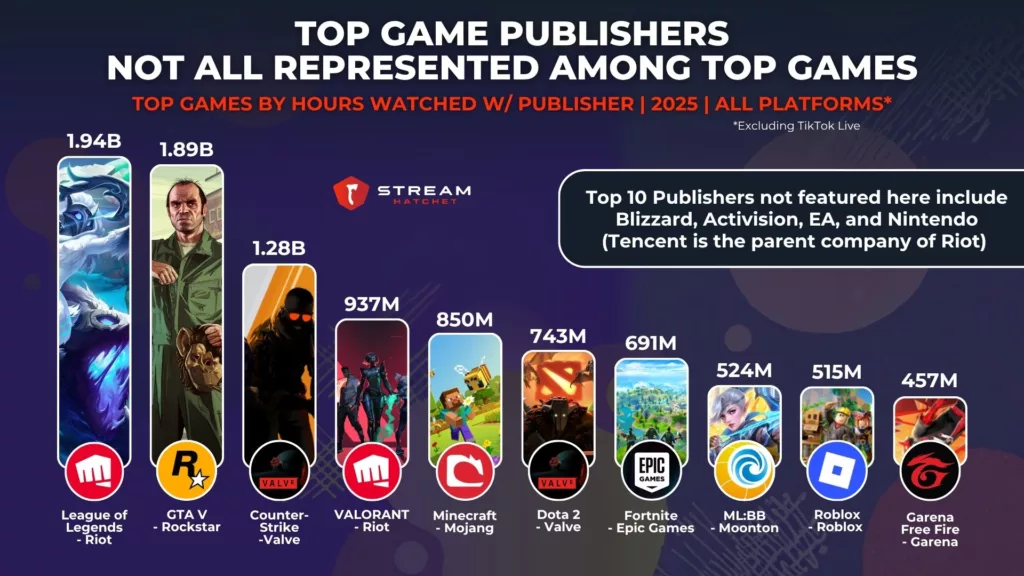
One obvious assumption is that the top 10 publishers would line up with the top 10 games on streaming for 2025. And you’d be mostly right in thinking that. Riot and Valve each hold two spots in the rankings, with League of Legends (1.94B), VALORANT (937M), Counter-Strike (1.28B), and Dota 2 (743M). It’s also worth noting that Tencent is the parent company of Riot Games, meaning LoL and VALORANT‘s combined 2.87B hours connects back upstream to the same corporate family.
But! Four of our featured publishers from the previous graphic (Blizzard, Activision, EA, and Nintendo) don’t appear in the top 10 games at all, which says less about their overall reach and more about how their viewership is structured: Spread across a portfolio rather than anchored by one defining title. Different publishers with that “all eggs in one basket approach” like Moonton, Roblox Corporation, and Garena all DO make the Top 10 though, thanks to Mobile Legends: Bang Bang, Roblox, and Garena Free Fire respectively. So, which of our featured publishers are building broad, multi-game viewership bases, and which are focusing their efforts on a single title?
Which Publishers Diversify, and Which Publishers Go All In?
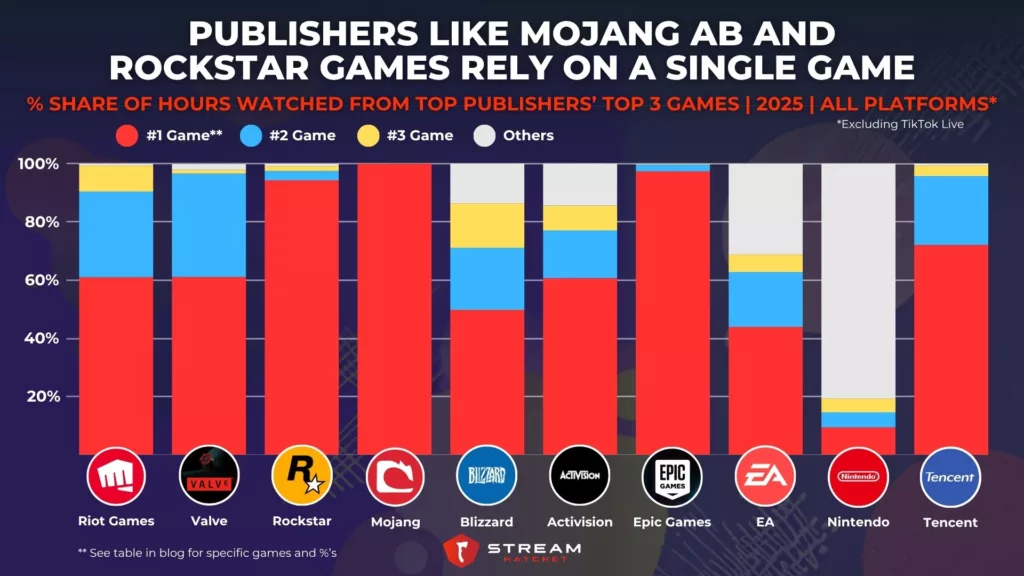
Most of our featured publishers focus on just a select few games, let alone franchises. Mojang is the extreme case, with Minecraft accounting for 100% of their hours watched. Rockstar isn’t far behind: GTA V was responsible for 94.3% of their total viewership in 2025, leaving Red Dead Redemption II and GTA: San Andreas to split the remaining scraps. For a publisher sitting at 2.01B hours watched, that level of concentration could be seen as vulnerability: It makes the upcoming launch of GTA VI pivotal to their ongoing success.
| Publisher | Game 1 % | Game 2 % | Game 3 % | Other % | Game 1 | Game 2 | Game 3 |
| Riot | 61.0 | 29.4 | 9.0 | 0.6 | League of Legends | VALORANT | Teamfight Tactics |
| Valve | 61.1 | 35.5 | 1.3 | 2.0 | Counter-Strike | Dota 2 | Deadlock |
| Rockstar | 94.3 | 3.2 | 1.7 | 0.8 | GTA V | Red Dead 2 | GTA: San Andreas |
| Mojang | 100.0 | 0.0 | – | – | Minecraft | Cobalt | – |
| Blizzard | 49.8 | 21.3 | 15.3 | 13.7 | World of Warcraft | StarCraft | Hearthstone |
| Activision | 60.7 | 16.4 | 8.5 | 14.5 | CoD: Warzone | CoD: Black Ops 6 | CoD: Black Ops 7 |
| Epic | 97.4 | 2.3 | 0.2 | 0.1 | Fortnite | Fall Guys | Alan Wake 2 |
| EA | 43.9 | 18.9 | 6.0 | 31.2 | Apex legends | Battlefield 6 | EA Sports FC 24 |
| Nintendo | 9.4 | 5.2 | 4.7 | 80.8 | Mario Kart World | Pokémon Legends: Z-A | Mario Kart 8 |
| Tencent | 72.1 | 23.7 | 3.6 | 0.7 | PUBG Mobile | Arena of Valor | Honor of Kings |
Riot and Valve present a more balanced picture, though with a notable distinction. Both have a #1 game sitting around 61% of their total, but Valve carries stronger depth at #2: Dota 2 accounts for 35.5% of their hours watched compared to VALORANT‘s 29.4% for Riot. Deadlock could further diversify Valve’s offerings, contributing 1.3% despite still being in closed access. Activision seems similarly diversified on paper, but its top 3 titles are all from just one franchise: Call of Duty, with Warzone, Black Ops 6, and Black Ops 7 together accounting for 85.6% of Activision’s total.
At the other end of the spectrum, Blizzard stands out as the most balanced publisher here, with no single title cracking 50% and three games each holding meaningful shares. World of Warcraft leads at 49.8% alongside StarCraft and Hearthstone. EA tells a similar story, with Apex Legends leading at 43.9% alongside solid contributions from Battlefield 6 and EA Sports FC 24. Nintendo is the most unusual case: Its #1 game Mario Kart World accounts for just 9.4% of their total (following the Switch 2 launch), with 80.8% spread across a wide catalog. This spread reflects Nintendo’s long history and beloved library of franchises.
Publishers With The Highest Number of Popular Games on Live Streaming
Speaking of having a diverse library of games supported by live-streaming audiences, we wanted to look not just at the relative contribution of each game but the gross hours watched of games within each publisher’s library. The red bars in the graphic below show the minimum number of games accounting for 98% of the publisher’s viewership (relative measure), and the white bars show the number of games that generated over 100K hours watched in 2025 (gross measure).
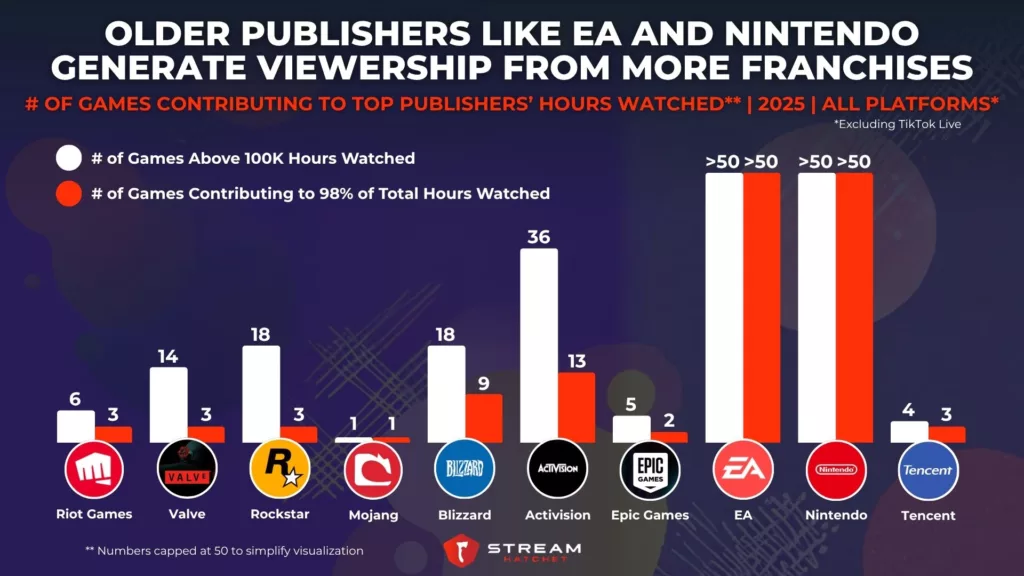
The relative measure reinforces what the previous graphic showed in a more simplified manner, For Mojang, just 1 game covers 98% of their viewership. Epic Games needs only 2 games to hit 98% with Fortnite carrying almost everything. Riot, Valve, and Rockstar each need only 3. Activision is the most interesting case: It takes 13 games to account for 98% of their total, with their viewership being more distributed across their Call of Duty back catalog than it might first appear. Then we have the more diverse publishers: Blizzard sits at 9, reflecting that genuinely multi-franchise spread we saw earlier. And Nintendo and EA are both well above 50 titles here, though we’ve capped the graphic at 50 for simplicity’s sake.
The gross measure adds a different dimension entirely. EA and Nintendo both still exceed 50 games above the 100K hours watched threshold, a level of catalog vitality that no other publisher in this group comes close to matching. Activision has 36, and Blizzard has 18, both reflecting deep libraries with genuine staying power. But what we find most interesting is that Valve and Rockstar actually have more success across more games than the relative measure suggested, with 14 and 18 games respectively bringing in over 100K hours watched. In these two cases, the overwhelming success of just two of their titles (GTAV and Counter-Strike) drowned out the signal from their other games, but those games are still performing objectively well.
_
These 2025 live-streaming publisher rankings reveal very different paths to the top:
- Rockstar and Mojang are riding the extraordinary longevity of single franchises that have become cultural institutions thanks to UGC-style elements (see also: Roblox).
- Publishers like Riot and Valve have built viewership empires on a small number of franchises with ferocious, loyal audiences and deep esports ecosystems
- Old guard publishers like EA and Nintendo which lean on fans of their decades-old franchises to generate viewership from many sources.
_
For publishers in any of these camps, understanding exactly where their live-streaming audience comes from, which games are growing or fading, and which streamers are driving the most engagement, is essential. Publishers with fewer successful games depend upon rewarding their most loyal creators, and publishers with more successful games (but which are older) need to create community events to keep those games relevant. Running any of these strategies, of course, requires detailed live-streaming data to plan accordingly.
To keep up to date with the latest rankings and insights into the live-streaming industry, follow Stream Hatchet and receive exclusive newsletter-only content: