TL;DR Takeaways by Stream Hatchet:
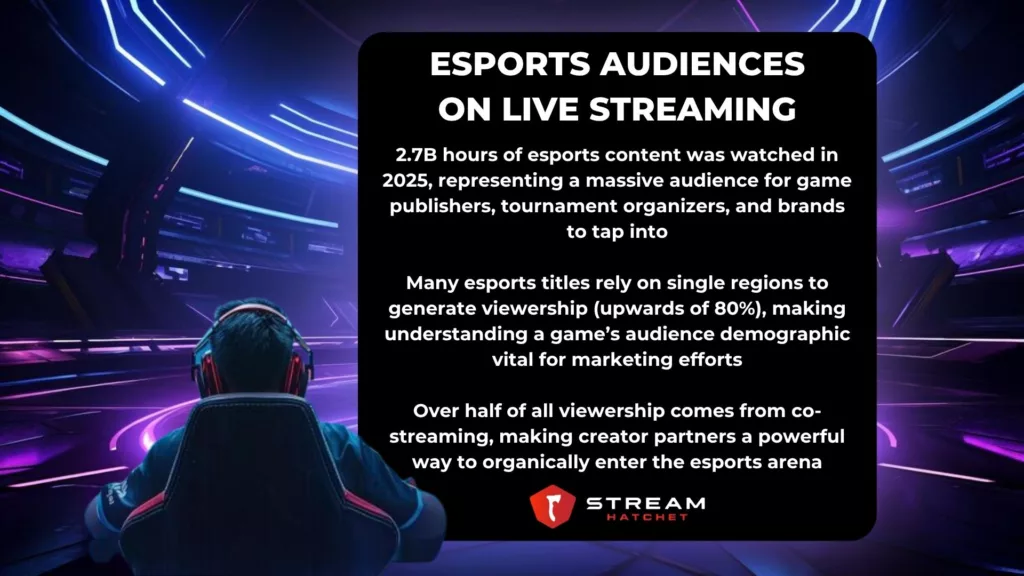
- 2.7B hours of esports content was watched in 2025, representing a massive audience for game publishers, tournament organizers, and brands to tap into
- Many esports titles rely on single regions to generate viewership (upwards of 80%), making understanding a game’s audience demographic vital for marketing efforts
- Over half of all viewership comes from co-streaming, making creator partnerships a powerful way to organically enter the esports arena
_
Esports pulled in 2.7B hours watched in 2025… that’s huge. It’s more than the total hours of live NBA coverage watched across linear and streaming platforms (League Pass excluded) in every market that year. The scale is impossible to ignore for sponsors, with multi-game tournaments like the Esports World Cup 2025 bringing the industry to a global audience.
But when we say “global audience”, what does that really mean? Where are esports audiences tuning in from, and what are they choosing to watch exactly? In this article, we walk through what that breakdown looks like: Tournament formats, streaming platforms, regions, and the importance of co-streamers in magnifying an event’s reach. What we’re discussing here is just a small slice of our recently released Esports Trends Report: If you want to dive right into the deep end, you can get the full report right now:
Big Productions and High Stakes Draw The Largest Audiences
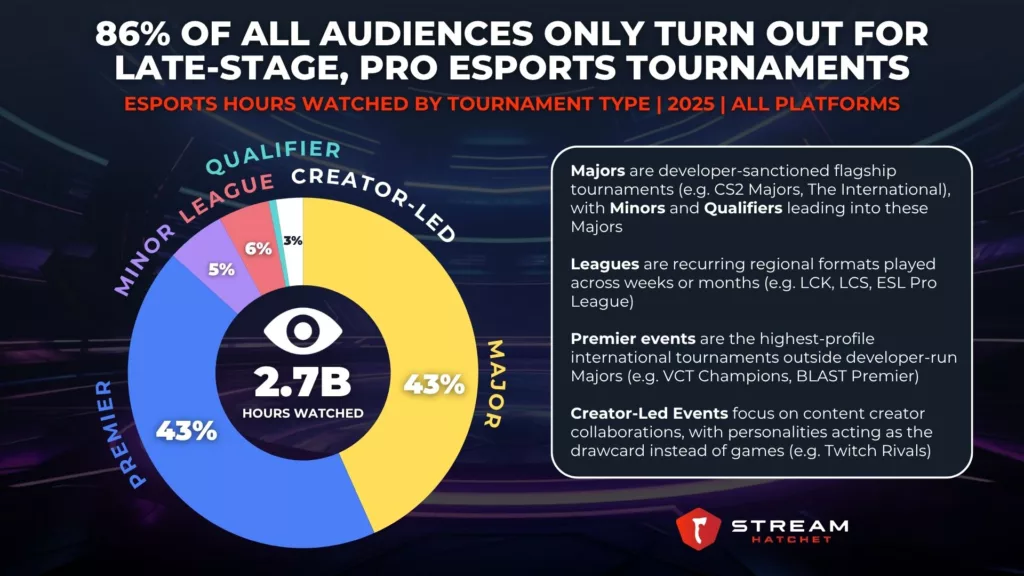
Esports viewership in 2025 crowded almost entirely around the top of the competitive pyramid. Majors and Premier events (think CS2 Majors, The International, VCT Champions) combined for 2.4B hours watched, splitting an even 43% share each and accounting for 86.4% of total esports HW. Everything else (Minors, Leagues, Qualifiers) was left fighting over the remaining 13.6%. Stakes, talent, and production value peak at the top of the ladder, and the hours watched follow suit almost exactly.
That remainder still throws up some surprises, though. Minor events out-hustled League formats, 149.5M hours watched to 129.2M, despite Leagues like LCK and LCS running for months across multiple regions. In other words: A format that wraps up in a couple of weeks beat one that occupies the calendar almost year-round. Longevity isn’t a substitute for stakes: Minors compress urgency into a tight window, and that’s proving more compelling than Leagues fans can tune into whenever.
Twitch and YouTube Gaming Have Turned Esports Into a Two-Platform Race
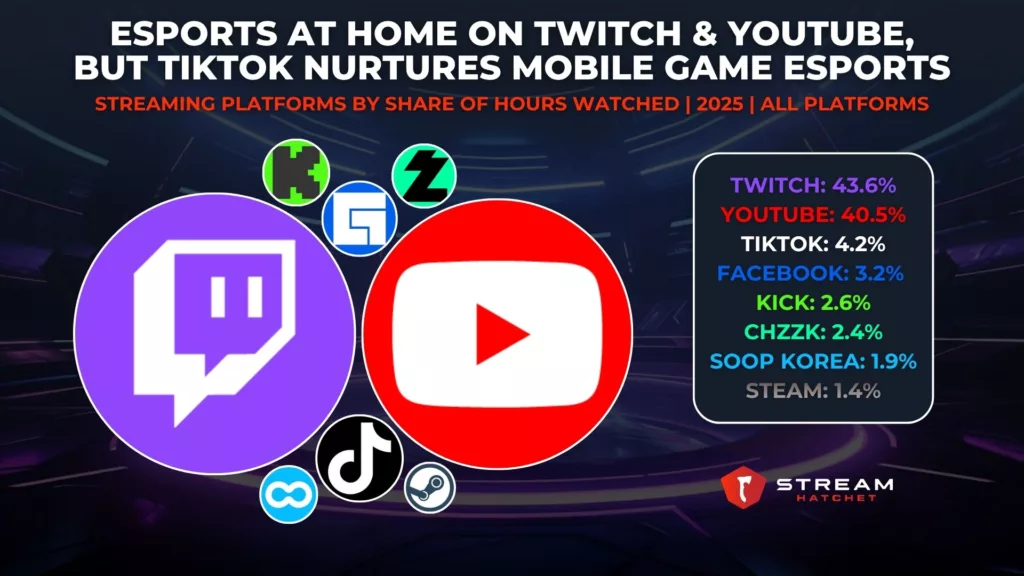
Twitch and YouTube Gaming have carved up esports viewership between themselves, and the split is tighter than you’d expect. Twitch leads with 1.2B hours watched (43.6%), but YouTube Gaming trails by just 83.8M hours at 1.1B (40.5%), together accounting for 84.1% of all esports HW in 2025. YouTube Gaming is closing the gap fast, eating into a lead Twitch once held comfortably. After the top two, the drop-off is brutal. TikTok claims a distant 3rd at 116.3M hours (4.2%), nearly 1B hours behind YouTube Gaming, and nothing else on the list gets remotely close.
Fun fact: TikTok’s bronze medal barely survives the podium. Chzzk and SOOP Korea combined for 117.8M hours, just ahead of TikTok’s 116.3M, despite being two Korea-specific platforms going up against a global app with audiences everywhere. South Korea’s esports viewership continues to punch well above its market size, a trend we’ve dug into before in our Chzzk deep-dive.
Some Esports Titles Live and Die by a Single Region
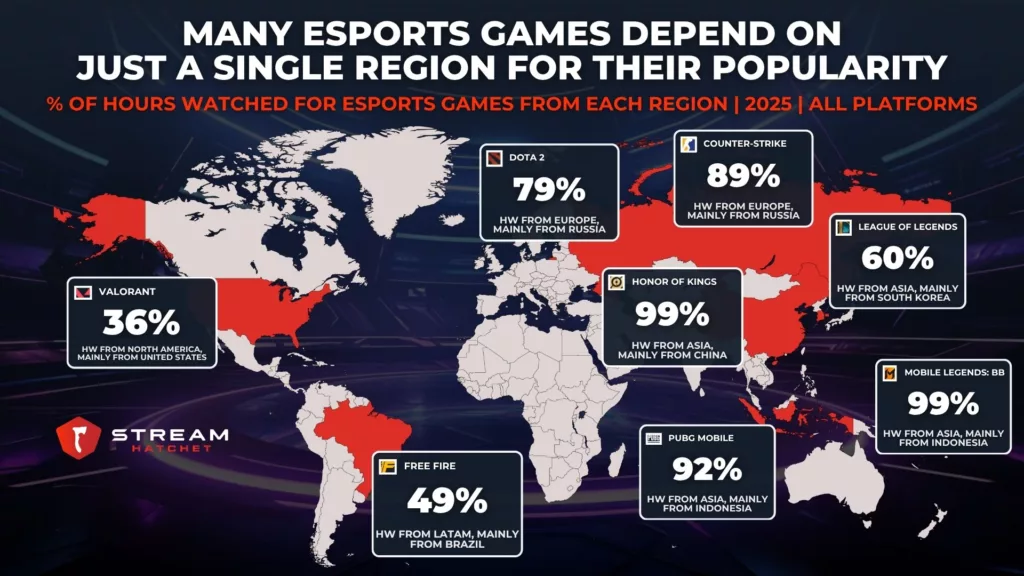
Esports viewership skews heavily regional, and a handful of titles take that to the extreme. Honor of Kings and Mobile Legends: Bang Bang (ML:BB) both pull 99% of their HW from Asia, with Honor of Kings anchored almost entirely in China and ML:BB in Indonesia, a concentration that played out vividly during ML:BB‘s M7 World Championship in Jakarta.
Counter-Strike and Dota 2 lean just as hard on Europe, at 89% and 79% HW respectively, mainly from Russia, proof that even the biggest global titles by total viewership can still call one continent home. VALORANT breaks the mold here: Just 36% of its HW comes from North America, making it the most globally spread title on this list.
The best example of regional mismatch, though, comes from Brazil. Garena Free Fire draws 49% of its HW from LATAM, mainly Brazil, despite Free Fire itself operating out of Singapore. That’s a title built and headquartered on one side of the world finding its real home on the other, a reminder that a publisher’s location doesn’t always determine where its audience watches from. This kind of regional breakdown matters well beyond marketing for the event itself: It’s also what determines which brands will be interested in sponsoring the event to tap into those specific regional audiences.
Co-Streaming Has Become Half of Esports Viewership
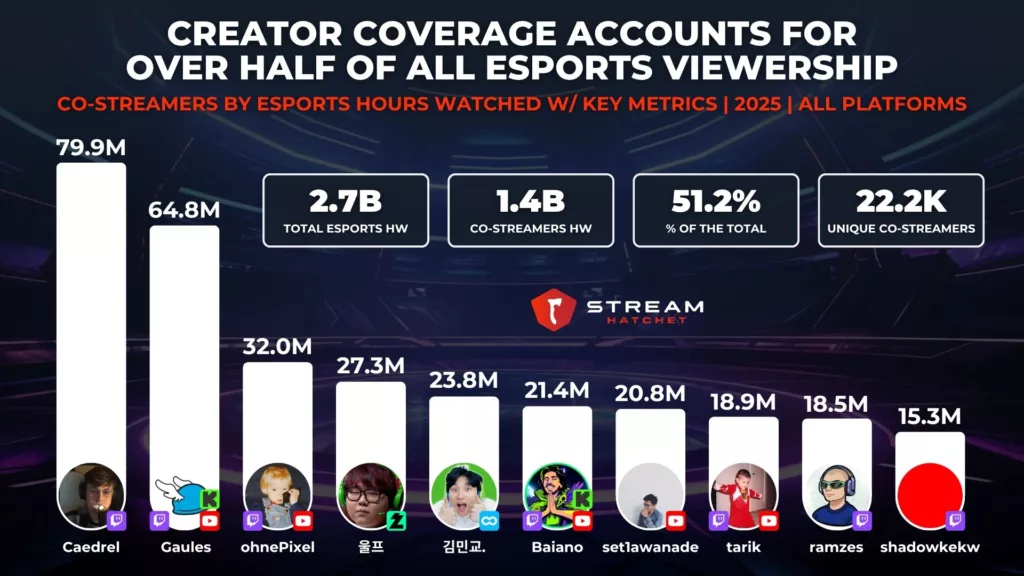
Co-streaming now carries half of all esports viewership. Co-streaming accounted for 1.4B of the 2.7B total esports HW in 2025, a 51.2% share, putting creator coverage on equal footing with official broadcasts. It’s not the first time creators have out-drawn the broadcast booth either: Co-streams beat official viewership outright at the Six Invitational, and similar creator-led surges drive some of esports’ biggest events. Language plays a part too: The Top 10 co-streamers alone cover English, Portuguese, Korean, French, and Ukrainian-speaking audiences, filling gaps official broadcasts can’t always reach on their own.
But that coverage isn’t evenly spread. Caedrel and Gaules combined for 145M hours, roughly 10.6% of all co-stream HW, out of a pool of 22.2K unique co-streamers. A tiny handful of personalities are carrying a wildly disproportionate share of the total. Genre matters just as much as personality here: set1awanade’s 20.8M hours, all on YouTube, mark ML:BB’s only Top 10 appearance, and the platform choice is the real point. Mobile esports has built its viewership home away from the Twitch-first default the rest of this list leans on, a pattern that lines up with YouTube Gaming’s fast-closing gap on Twitch overall.
_
Esports audiences don’t sit still. A platform gaining ground today, a region punching above its weight, a co-streamer pulling in more viewers than the official broadcast… all of that can shift within a single tournament cycle, let alone a full year. The Twitch and YouTube Gaming split alone has moved noticeably over the past 5 years. Standing still isn’t really an option for organizers, publishers, or brands trying to keep pace, since the version of “where the audience is” that worked last year might already be out of date.
Staying on top of that shift takes more than a single snapshot. We go a lot deeper into evolving esports trends and the tools needed to track them in our full Esports Live Streaming Trends Report:
_
To keep up to date with the latest trends shaping live streaming, follow Stream Hatchet and receive exclusive newsletter-only content: